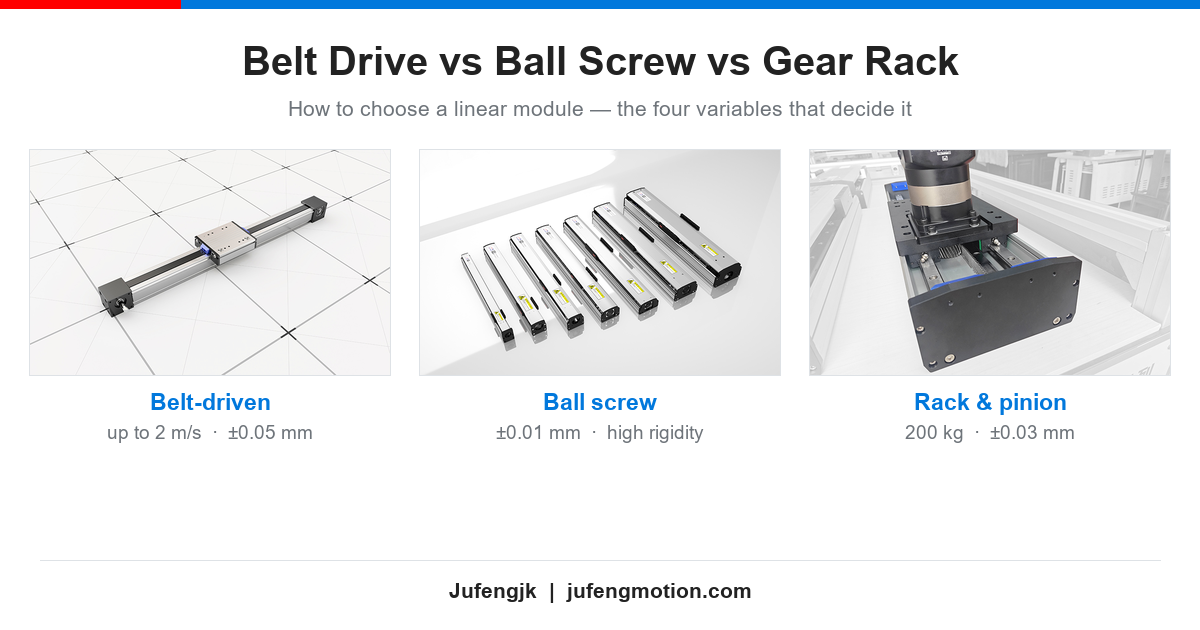
Belt Drive vs Ball Screw vs Gear Rack: How to Choose a Linear Module
Choosing a drive type is the one decision that fixes almost everything else about a linear axis — its speed ceiling, its accuracy, its maximum stroke, and what it costs to own over ten years. Three drive types cover nearly every industrial application: timing belt, ball screw, and rack and pinion.
This guide compares them on the four variables that actually decide the answer: load, speed, accuracy, and stroke.
The three drive types in one line
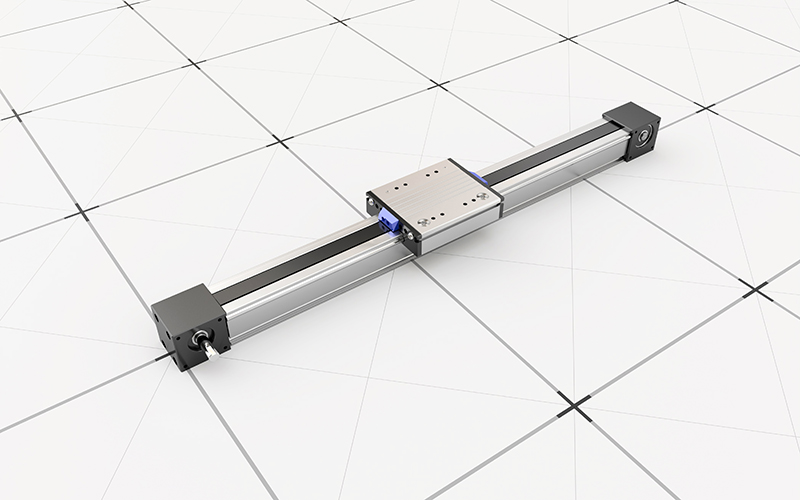
Belt-driven — a timing belt converts pulley rotation into linear travel. Light, fast, and economical to extend.
Ball screw — a recirculating ball nut runs along a precision-ground screw. The accuracy and rigidity benchmark.
Rack and pinion — a pinion gear drives along a steel rack. Built for very long travel and heavy thrust.
Side-by-side comparison
| Variable | Belt-driven (WDT series) | Ball screw (JFJK-S series) | Rack & pinion (JFJK-C series) |
|---|---|---|---|
| Repeat positioning accuracy | ±0.05 mm | ±0.01 mm | ±0.03 mm |
| Maximum speed | up to 2 m/s | Limited by screw critical speed — moderate | High — not limited by lead length |
| Maximum stroke | up to 4,000 mm | Grows with screw length; long screws need extra support | over 10,000 mm |
| Horizontal load | Moderate | High | up to 200 kg |
| Rigidity | Moderate — belt stretch under reversing load | High — preloaded nut | High — hardened steel rack |
| Cost behaviour on long travel | Stays low — belt and profile are modular | Rises sharply — screw length, whip and support | Stays low — rack is modular |
| Maintenance | Low — belt tension check | Lubrication-dependent | Lubrication-dependent |
Values above are series-typical. Final figures depend on your selected model, stroke and duty cycle — contact us for the datasheet of the exact configuration.
The four variables that decide it
1. Load and thrust
Start with the mass being moved, then work out the force needed to accelerate it — not just to hold it. A belt axis handles a light moving mass very efficiently, but the belt itself is the weak link once thrust climbs. A ball screw transmits far higher axial force because the load travels through a preloaded nut. A rack and pinion takes that further: our gear and rack modules support horizontal loads up to 200 kg.
2. Speed and duty cycle
For high-cycle automation, belt drive is usually the answer — up to 2 m/s, which is why you find it in pick-and-place and packaging lines. Ball screws are limited by the screw's critical speed and by inertia, so they are the choice when accuracy matters more than cycle time. The variable people forget is duty cycle: a belt running continuously at high speed wears as a consumable, which is acceptable when you plan for it and expensive when you do not.
3. Accuracy
Repeat positioning accuracy is the number that determines whether your machine can hold a process window. Ball screw actuators reach ±0.01 mm repeatability. Belt-driven modules are typically quoted at ±0.05 mm, and our gear and rack modules at ±0.03 mm. Note that repeatability and absolute accuracy are different things — most automation depends on the first, metrology on the second.
4. Stroke
Stroke is where the decision often makes itself. Our belt-driven modules reach 4,000 mm. A ball screw can be made longer, but length brings screw whip, sag and the need for support, so cost climbs steeply. Rack and pinion has no such limit — the rack is modular, so travel exceeds 10,000 mm without the cost penalty.
Which drive for which machine
Packaging, pick-and-place, laser marking, CNC routing — belt-driven linear modules. High cycle rates, long strokes, predictable cost.
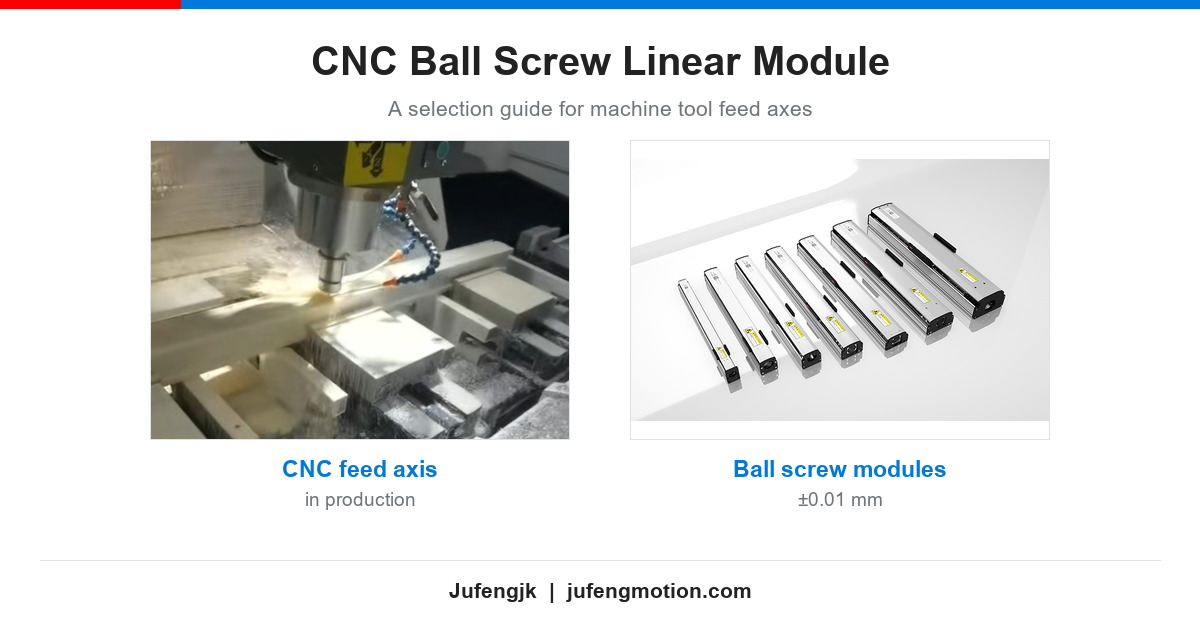
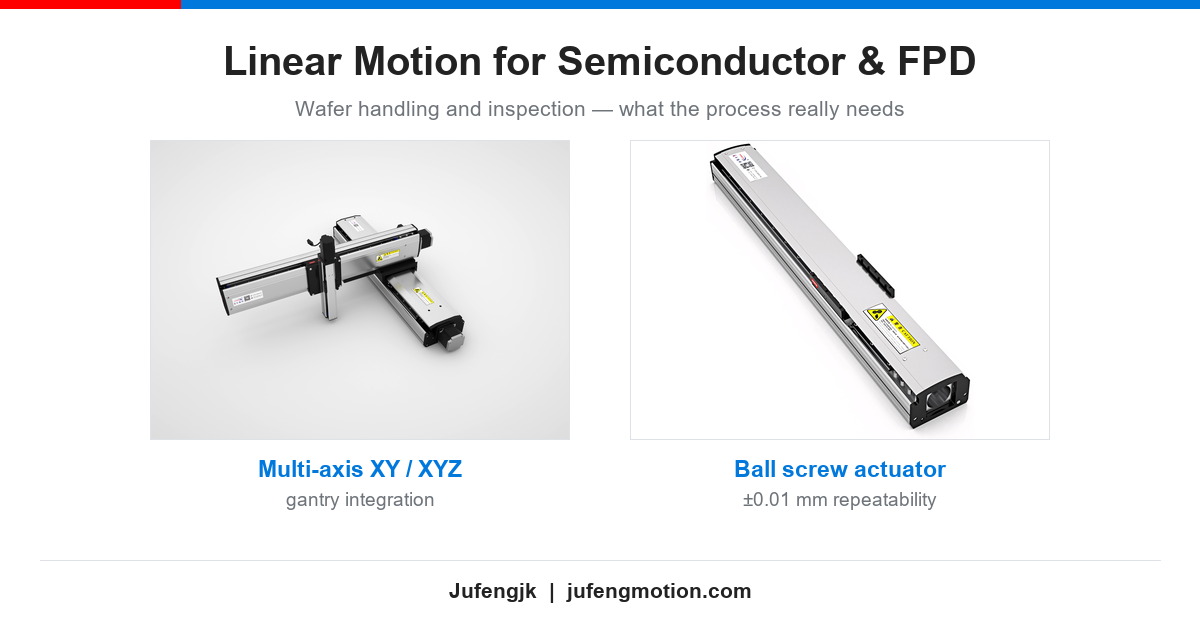
CNC machining, semiconductor, and any vertical axis — ball screw linear actuators. ±0.01 mm repeatability and the rigidity a vertical axis needs.
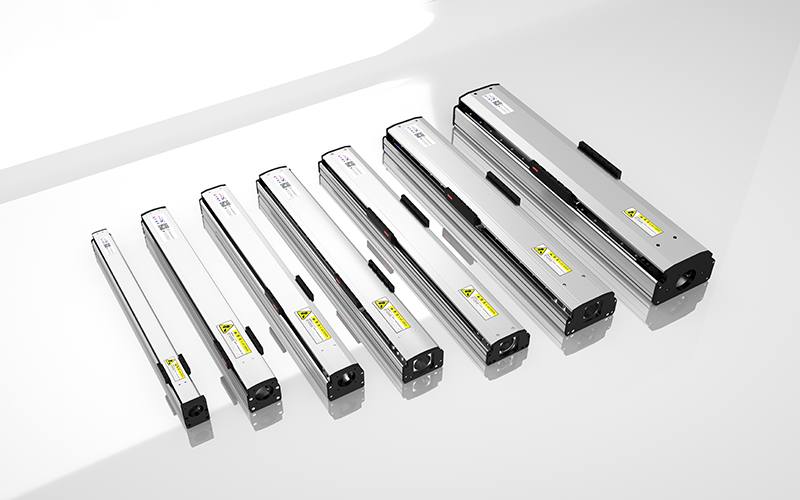
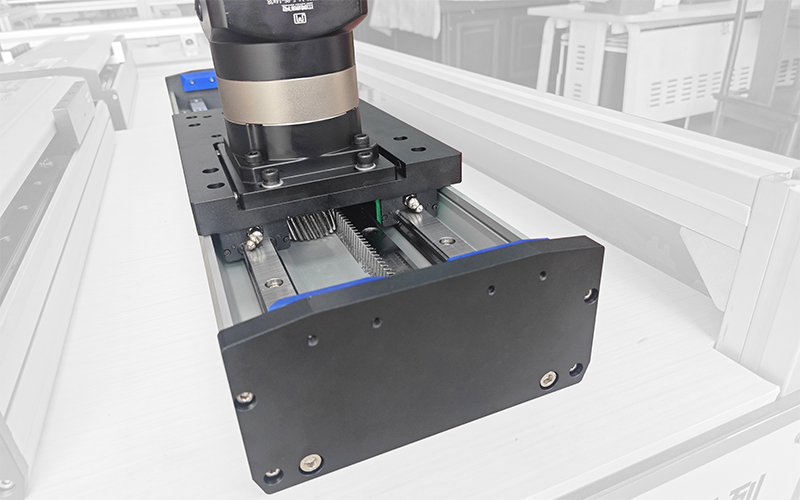
Large gantry robots, large-format laser cutting, heavy material transport — gear and rack linear modules. Long travel with the thrust to move real mass.
For a closer look at the two most common options, see our earlier comparison of belt-driven vs ball screw linear modules.
Three selection mistakes we see most often
Choosing on accuracy alone. A ±0.01 mm screw on a six-metre axis is an expensive way to get whip, sag and a support problem. Match the drive to the stroke first, then refine on accuracy.
Ignoring the vertical axis case. A vertical axis has to hold position with power off. That means a brake, or a drive with inherent holding ability — decide this before you choose the drive type, not after.
Ignoring duty cycle and environment. Belt tension, lubrication interval and dust protection all change the answer. A dust-proof enclosure is not a cosmetic option when the axis runs in a machining environment.
When the right answer is a custom axis
Most projects do not fit a catalogue line exactly. We build modular rack and pinion axes in three profile widths — JFJK135C, JFJK170C and JFJK220C — and customise belt and ball screw modules to your effective stroke. Installation drawings, dimensional drawings and 2D/3D CAD files are available on request.
Summary
Belt for speed and long stroke at low cost. Ball screw for accuracy and rigidity. Rack and pinion for very long travel under heavy load. Get those four variables — load, speed, accuracy, stroke — on one page before you look at models, and the drive type almost always picks itself.
Send us your load, speed, accuracy requirement and stroke length. We will come back with the drive type, the model and the drawings. Contact us or message us on WhatsApp at +86 137 9839 6296.