CNC Ball Screw Linear Module Selection Guide
Rigid, low-backlash ball screw modules with repeatability down to ±0.01 mm class
Step-by-step checklist: accuracy, lead, load, critical speed, sealing and duty cycle
Clear guidance on long-stroke limits — and when to switch to rack & pinion or linear motors
CNC Ball Screw Linear Module Selection Guide
Whether you are building a compact CNC mill, upgrading the feed axis of an existing machine, or adding an automatic loading station to a grinding cell, the linear motion system decides how accurate, how rigid and how repeatable your machine really is.
Ball screw linear modules — integrated units of a precision ball screw, linear guide rails, and a machined housing — have become the default choice for CNC builders and retrofit engineers who need sub-millimeter-to-micron-level positioning without designing their own transmission from scratch. This guide walks through the applications, the selection parameters that actually matter, and the mistakes to avoid when specifying a linear module for CNC machining.
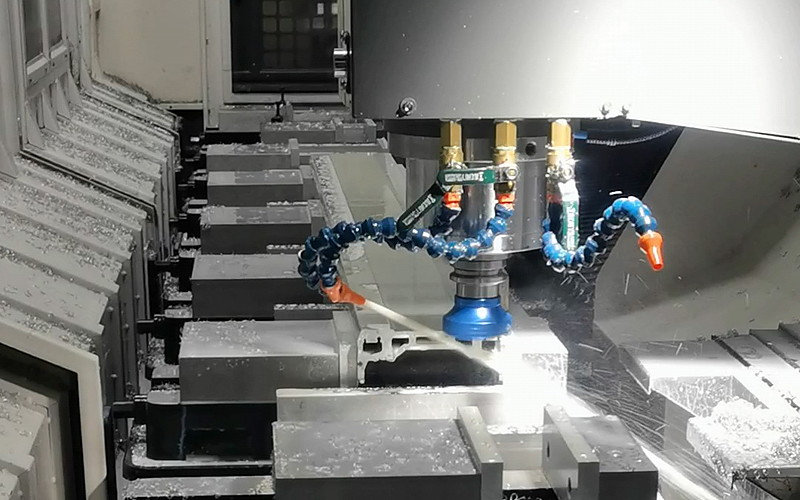
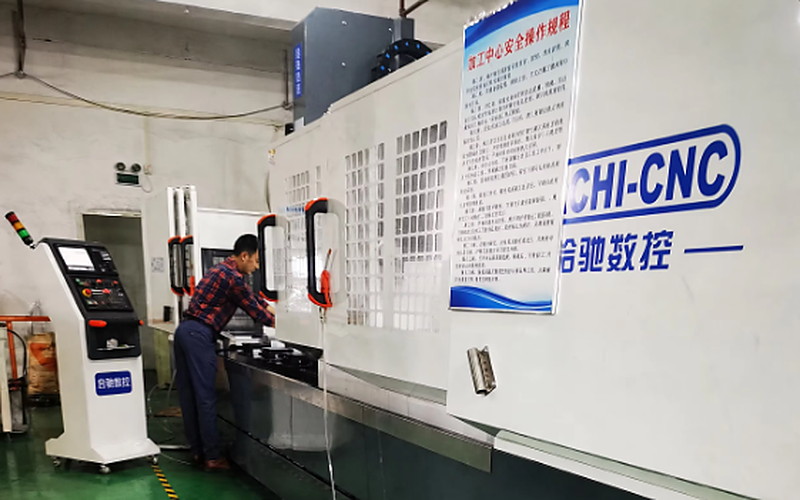
Why Linear Modules Matter in CNC Machining
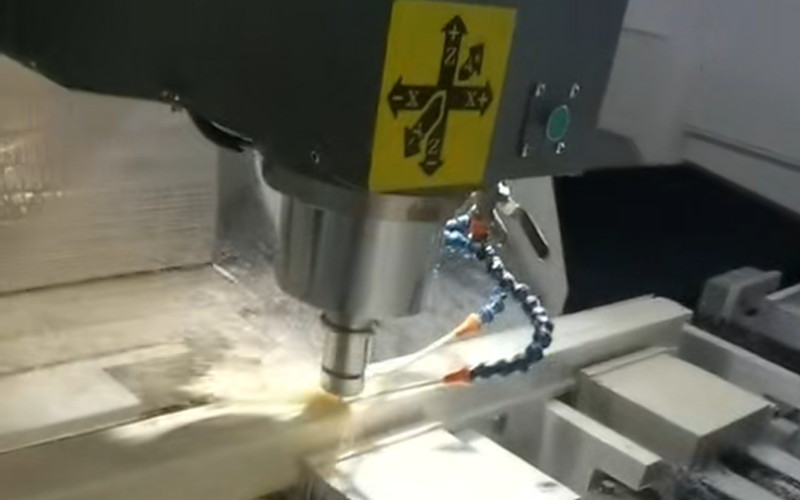
A CNC machine is only as good as its axes. The feed system must convert motor rotation into smooth, stiff, predictable linear motion under cutting forces, chips and coolant. Buying a pre-engineered ball screw linear module instead of assembling rails, screws and brackets separately gives you three advantages:
-
Factory-aligned accuracy. The screw and rails are mounted and preloaded on a precision base by the manufacturer, so you inherit a tested straightness and repeatability spec instead of hoping your assembly holds tolerance.
-
Predictable rigidity. Preloaded ball nuts and matched rail blocks minimize deflection and backlash under load — the two enemies of good surface finish.
-
Faster time to market. A standard module ships with documentation and drawings, cutting engineering hours from your project. Many suppliers, including JUFENG's JFJK series, offer semi-finished and fully customized modules with repeatability down to ±0.01 mm class.
Common CNC Applications for Ball Screw Linear Modules
Linear modules appear across the machining floor, not just inside the machine tool:
| Application | Typical requirement | Recommended module |
|---|---|---|
| Feed axes of small/medium CNC mills and machining centers | High rigidity, low backlash, long life | Ball screw module, semi- or fully enclosed |
| Surface and cylindrical grinding machines | Low vibration, high stiffness, coolant resistance | Fully enclosed ball screw module with wipers |
| Lathe automation (loading/unloading, tailstock positioning) | Medium speed, reliable repeatability | Ball screw module, compact profile |
| Machine tool retrofits (converting manual machines to CNC) | Easy integration, documented dimensions | Standard ball screw module + servo kit |
| Parts handling, tool changers, pallet shuttles | Speed + precision balance | Ball screw module or belt module depending on speed |
For retrofit projects in particular, a standard module is attractive: you get a complete axis with known performance, and your control system only needs to talk to the motor.
The Selection Parameters That Actually Matter
Specifying a module by "stroke and price" is the fastest way to a disappointing machine. Work through this checklist instead:
1. Accuracy and Repeatability
Define what the machine must hold — positioning accuracy and repeatability are different numbers. Industry grades run from standard (±0.02–0.05 mm) to precision (±0.01 mm and better) classes. For CNC finishing work, look for modules quoting both a positioning accuracy and a repeatability figure, and ask which ball screw grade (e.g., C7/C5/C3) the module uses.
2. Lead vs. Speed
Lead = travel per screw revolution. High lead gives higher speed at the same motor RPM but reduces resolution and axial thrust. Match lead to your target feed rate and required thrust, not to the fastest number on the datasheet.
3. Load and Rigidity
Check axial (thrust) and radial/moment loads against the module's rated values, including acceleration forces. Preloaded ball nuts reduce backlash but increase drag — spec preload according to cutting forces, not lightly.
4. Stroke Length: Watch Critical Speed and Deflection
This is the parameter most often missed. A long, slender screw has two limits:
-
Critical speed: beyond a certain RPM the screw whips and vibrates. Critical speed drops as stroke grows — a 1000 mm screw can spin far faster than a 3000 mm one.
-
Deflection and sag: a long unsupported screw deflects under its own weight, hurting positioning consistency.
If your travel exceeds roughly 1.5–2 m at high speed, a ball screw may no longer be the right answer — see the comparison below.
5. Environment: Chips, Coolant, Dust
CNC environments are brutal for unprotected motion components. Decide between:
-
Semi-enclosed modules — for cleaner cells or where the module is away from the cutting zone.
-
Fully enclosed modules — sealed housing with wipers, the safer choice when coolant and cast-iron or aluminum chips are present. Scraping chips out of a screw is downtime you don't want.
-
6. Duty Cycle and Life
Estimate running hours per day and load profile. A module sized for a light lab machine will fail early on a 24/7 production axis. Ask the supplier for a life calculation based on your load and travel.
Ball Screw vs. Leadscrew vs. Rack & Pinion vs. Linear Motor
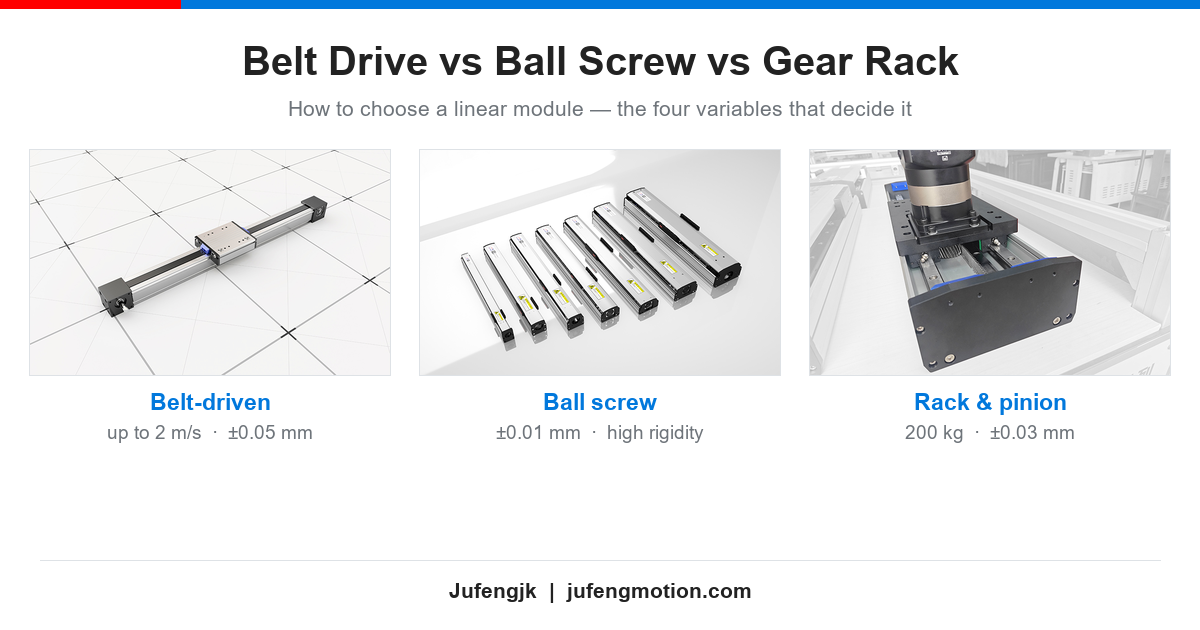
For a long-travel CNC axis, the ball screw is not always the winner. This comparison helps you decide:
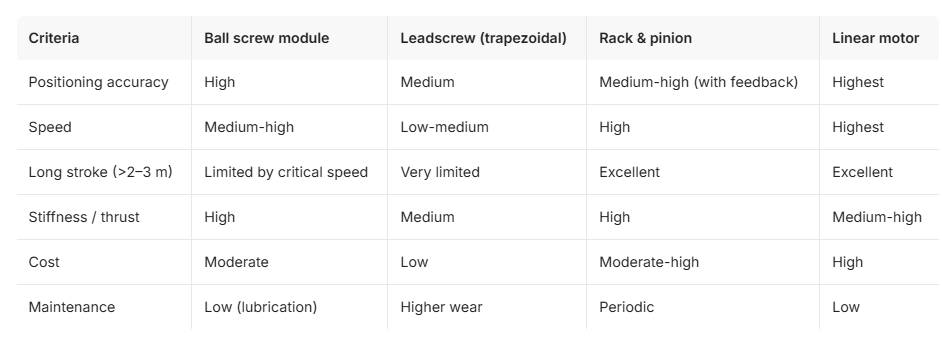
Rule of thumb: up to ~1.5–2 m at high precision, a ball screw module is the most cost-effective, rigid choice. Beyond that, consider rack-and-pinion gantry modules — like the custom gear-rack systems JUFENG builds for heavy machinery — or a linear motor if budget and control complexity allow.
Semi-Enclosed or Fully Enclosed? A Practical Answer
Ask one question: can coolant or chips reach the screw?
-
If yes — grinding machines, milling cells, cast-iron machining — choose fully enclosed modules with effective sealing. Wipers keep abrasive grit out of the ball nut, where it silently destroys accuracy.
-
If the module lives in a dry, clean zone (loading/unloading areas, inspection, handling), a semi-enclosed module saves cost and is easier to maintain.
For grinding applications, also confirm the module's surface treatment and sealing suits coolant type (water-soluble vs. oil-based).
Integration and Customization
A module is a component, not a finished machine. Plan for:
-
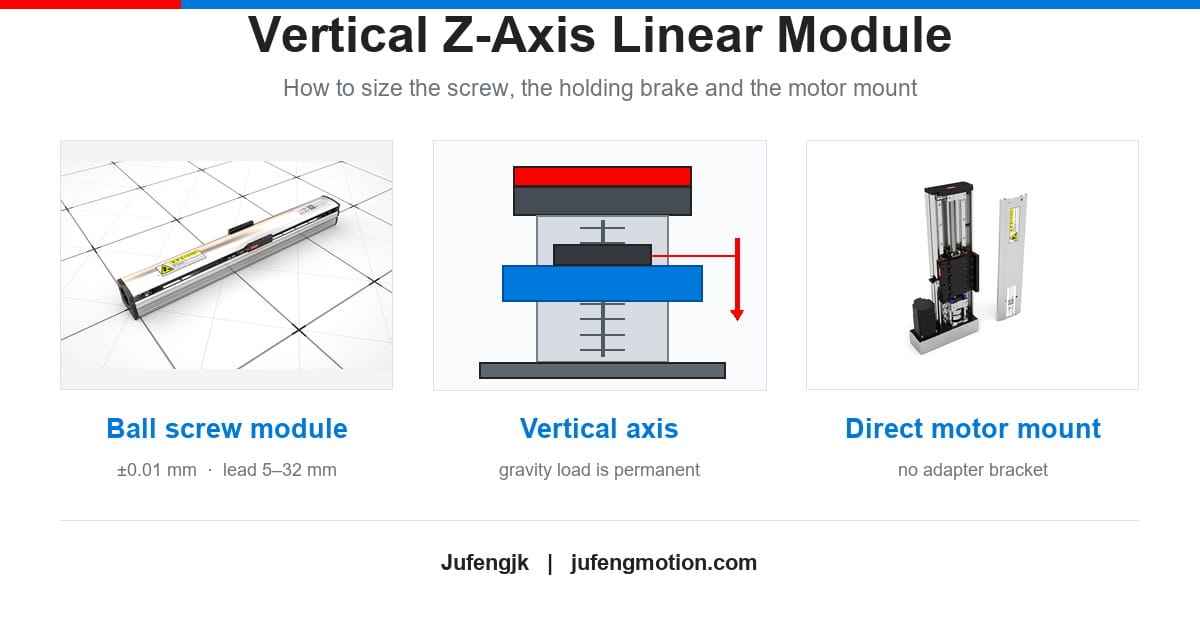
Motor mounting: flange or coupling types compatible with your servo/stepper; JUFENG provides matching motor brackets and couplings as part of one-stop sourcing.
-
Feedback: where resolution matters, consider modules compatible with linear encoders or high-resolution motor encoders.
-
-
Custom configurations: non-standard strokes, special materials, unusual mounting patterns — reputable suppliers machine and assemble to your drawing. JUFENG's in-house CNC milling, grinding and turning capabilities mean custom parts are manufactured under the same roof that tests the modules, with 2D/3D drawings provided before production.
-
Documentation: demand dimensional drawings, solution layouts and installation guidance before you commit. Good documentation is the difference between a smooth first build and a field headache.
-
Why Choose JUFENGJK for CNC Linear Motion
JUFENGJK (Shenzhen Jufeng Jingke Automation Technology Co., Ltd.) is a manufacturer of linear motion components and modules — belt-driven, ball screw, gear-rack and full complementary parts. For CNC applications specifically:
-
Machine builder's perspective: our own CNC milling, grinding and turning shop means we understand the tolerances your toolpath demands.
-
One-stop sourcing: module, servo mounting, couplings and spare parts from one supplier — one drawing set, one conversation.
-
Application engineering before ordering: tell us load, speed, duty cycle and environment; we recommend the right configuration and deliver drawings upfront.
-
Lifecycle support: installation guidance, troubleshooting, warranty and spare parts after delivery.
Ready to spec your CNC axis? Send your application details — stroke, load, speed, accuracy target and environment — to our engineering team through jfjkwaimao.com and get a configuration recommendation with drawings.
FAQ
Q: Can I retrofit an old manual machine with a ball screw linear module?
A: Yes. Standard modules with documented dimensions are commonly used to convert manual mills and lathes to CNC. Keep the module away from direct chip/coolant splash or choose a fully enclosed version, and confirm screw lead matches your servo/stepper and controller setup.
Q: How do I calculate critical speed for a long ball screw?
A: Critical speed depends on screw diameter, unsupported length and end-fixity. As a practical rule, longer strokes require larger-diameter screws or center/nut-driven designs; if the required speed approaches the critical speed limit, switch to rack-and-pinion or linear motor solutions. Ask your supplier to run the calculation for your exact stroke.
Q: What repeatability can I expect from a precision ball screw module?
A: Precision-class modules typically quote repeatability in the ±0.01 mm range and better, depending on ball screw grade, preload and feedback. Always verify the supplier's spec against your part tolerances rather than assuming.
Q: Fully enclosed or semi-enclosed — which should I pick?
A: If coolant, chips or dust can reach the module, choose fully enclosed. In dry handling and inspection zones, semi-enclosed is more economical. When in doubt, sealing is cheaper than downtime.
Q: Can you manufacture custom strokes and mounting?
A: Yes. Non-standard strokes, special materials and custom mounting are standard practice for us — our in-house CNC shop and engineering team deliver drawings for approval before production.
Conclusion
The right linear module turns a good control system into a reliable machine. Define accuracy and repeatability first, then work through speed, load, stroke limits and the working environment. For strokes up to about two meters at high precision, a ball screw module offers the best balance of cost, rigidity and accuracy — and when the travel grows beyond that, know when to step up to rack-and-pinion or linear motor systems.
And when the spec is clear, work with a partner who understands machining from the inside. Contact JUFENGJK at jfjkwaimao.com with your application parameters for a recommended configuration and engineering drawings.